
Springfield Address History Sources
No one record names all previous residents of a Springfield address. Each source covers a different slice of time and answers a different question. The current parcel card supplies the stable parcel number and legal description. Recorded deeds identify parties to land instruments, but not everyone who slept under the roof. Printed street sections and census schedules can supply occupant clues, including people who never held title. Maps and permit files describe the structure itself.
| Source | Verified era | Springfield access point | Evidence supplied |
|---|---|---|---|
| Recorder deed books | Scans to February 16, 1901; online data and images from 1982 | Sangamon County Recorder routes, counter, and microfilm | Transfers, parties, dates, and legal descriptions |
| City and county directories | Verified years from 1857–58 through selected 1987 volumes | Lincoln Library and established digital catalogs | Names, addresses, work, spouses, phones, and owner marks |
| Federal census | Released schedules through 1950 | Library genealogy databases and FamilySearch affiliate access | Household members at a census date |
| Sanborn maps | Springfield editions from 1890, 1906, and 1917, with later volumes | Library of Congress collection | Building footprint, use, materials, and street context |
| City permit and owner files | Series dependent; no public address portal found | Springfield City Clerk FOIA directory and request | Permit, applicant, owner, inspection, and numbering clues |
| Obituary cards and newspapers | Obituary card index from 1861 to the present | Lincoln Library Sangamon Valley Collection | Death date and newspaper-publication lead |
For a recent Springfield property, begin with the parcel card and deed chain. For a nineteenth-century or early twentieth-century question, start at Lincoln Library with a directory year near the date, then connect that entry to maps, newspapers, census schedules, and deeds. The source nearest the event is often the best lead, but a second record should confirm any name or date.
Springfield Parcels Before Names
A guessed surname is a weak starting point. The Sangamon County Property Tax Search accepts parcel number, owner name, house number, direction, street name, and city. Search the current Springfield street line, then save the parcel number, property address, mailing address, class, tax code, legal description, owner history, assessment history, sales details, and annexation links that appear for that parcel.
Keep the fields separate. The research sample showed a Springfield ZIP on the property side and an owner mailing address outside Illinois. A rural tract may have a legal description but no normal street line. Neither case proves who lives there. The parcel number and legal description are more durable than a mailing address, especially when a lot was split, merged, replatted, or brought into Springfield.
Note: A parcel owner is not automatically a resident, and a Springfield mailing line does not prove that the tract sits inside city limits.
Walk Springfield Deeds Backward
The Sangamon County Recorder Land Records Search indexes the people named in recorded instruments. A grantor is usually the seller and a grantee is usually the buyer. The chain of title is the linked sequence of those transfers. It is not the same as a list of previous residents. Trusts, estates, lenders, spouses, and business entities can appear in the chain even when they never occupied the Springfield property.
- Copy the current parcel number, owner field, legal description, and any latest deed locator from the parcel card.
- Find the current owner's purchase instrument. Record the grantor, grantee, date, document number or book and page, and description.
- Search the seller in the grantee role to locate that party's earlier purchase. Match the land, not merely the name.
- Repeat the link backward. Use subdivision, lot, plat, volume, page, and dates to resolve splits or name forks.
- When the web coverage ends, take the identifiers to the free public terminal and older microfilm or microfiche.
- Grantor and grantee
- The grantor transfers an interest; the grantee receives it.
- Chain of title
- The connected run of recorded transfers affecting the same land.
- Legal description
- The formal land description used to match a parcel when street names or numbers change.
- Instrument
- A recorded document such as a deed, mortgage, lien, easement, release, or plat.
Springfield Deed Access by Era
The Recorder reports online land data and document images from 1982 forward. Deed books are scanned back to February 16, 1901, and records from 1950 through 1969 are indexed and viewable online. Those facts do not mean that each older Springfield deed is easy to find from a street address. Material before the main index may require a document number, book and page, or research at the office.
The free data route omits document images. Tapestry charges by search, while Laredo uses an account. Free public terminals, counter help, mail, and phone remain important channels. The Recorder FAQ says staff may use a correct address to help locate an owner, but farm ground generally needs a parcel number. Staff do not conduct title searches or broad historical research. Copy requests may be made in person, by mail, or by phone, with an estimated return time of seven to ten business days.
The Recorder's own access summary is shown below. It explains why older Springfield previous residents research often moves from a web lead to the office.
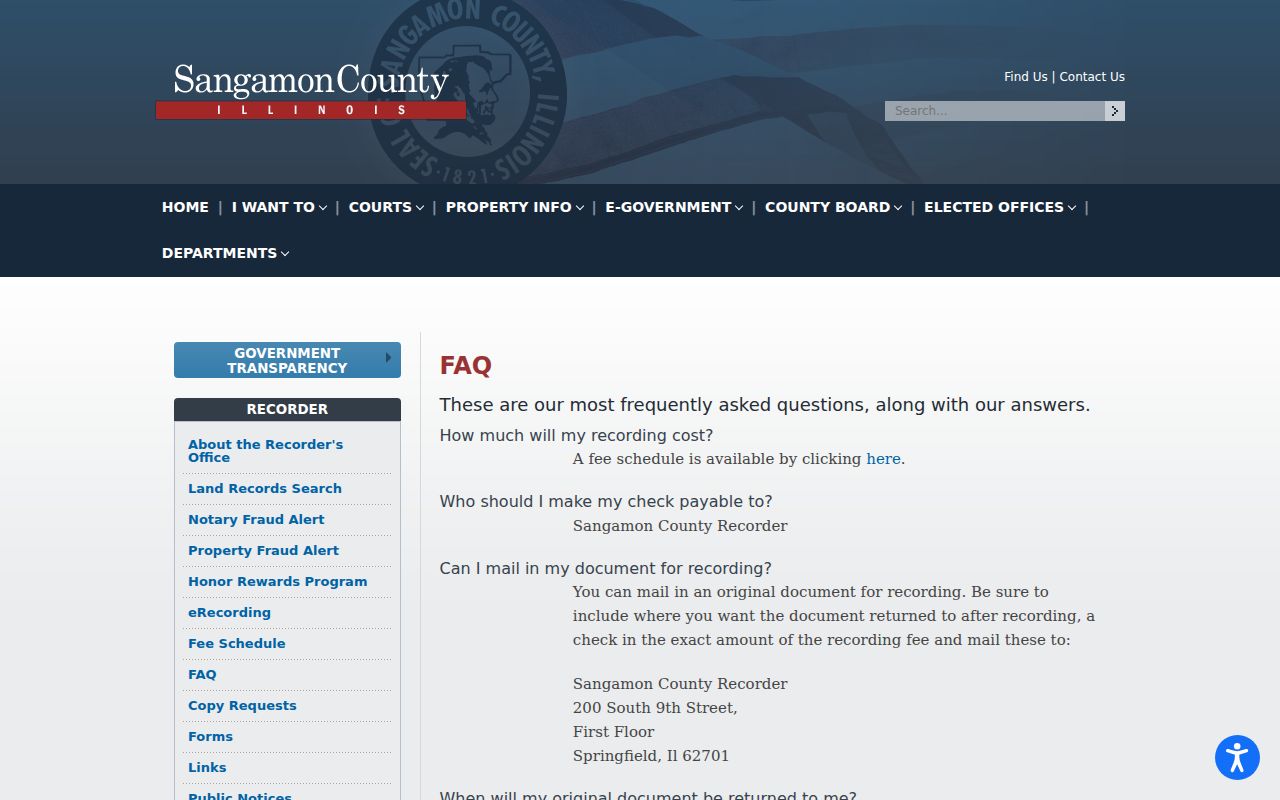
The page is most useful for planning the fallback route and understanding grantor and grantee mechanics before requesting a copy.
Springfield Households Between Deeds
Deeds trace land, while printed directories and census schedules help trace past residents. Springfield directory years verified by the research include 1857–58, 1866, 1868–69, 1876, 1889, 1892–93, selected years from 1924 through 1938, 1957–59, 1978, 1980, and 1987. Lincoln Library has a broader city and county directory collection, though its public site does not list every volume. Ask staff which street sections or reverse directories are available for the needed year.
A practical flow is: address in the street section, name in the alphabetical section, nearby directory years, closest released census, then newspaper and deed confirmation. The old entry may show initials, spouse, work address, phone, a residence mark, or an owner symbol. Compare cross streets and the side of the street when the number seems wrong. The full shelf and entry conventions belong on the Springfield city directory page; here, the directory's role is to fill the years between recorded transfers.
- Choose a directory just before and just after a known deed or permit date.
- Copy the entry exactly, including initials, spouse, abbreviations, phone, and owner mark.
- Check the nearest released census and account for ward or enumeration-boundary changes.
- Search the next older volume until the household changes, then seek a dated event that explains the move.
Springfield House History at SVC
The Sangamon Valley Collection guide brings together directories, maps, photographs, yearbooks, government and planning documents, local histories, newspapers, and vertical files. The third-floor collection is noncirculating. Its obituary card index begins in 1861 and gives both a death date and the date an obituary ran, which creates a precise bridge from a former Springfield name to the right newspaper issue.
The collection guide illustrates the range of material that can sit beside a deed or directory find.
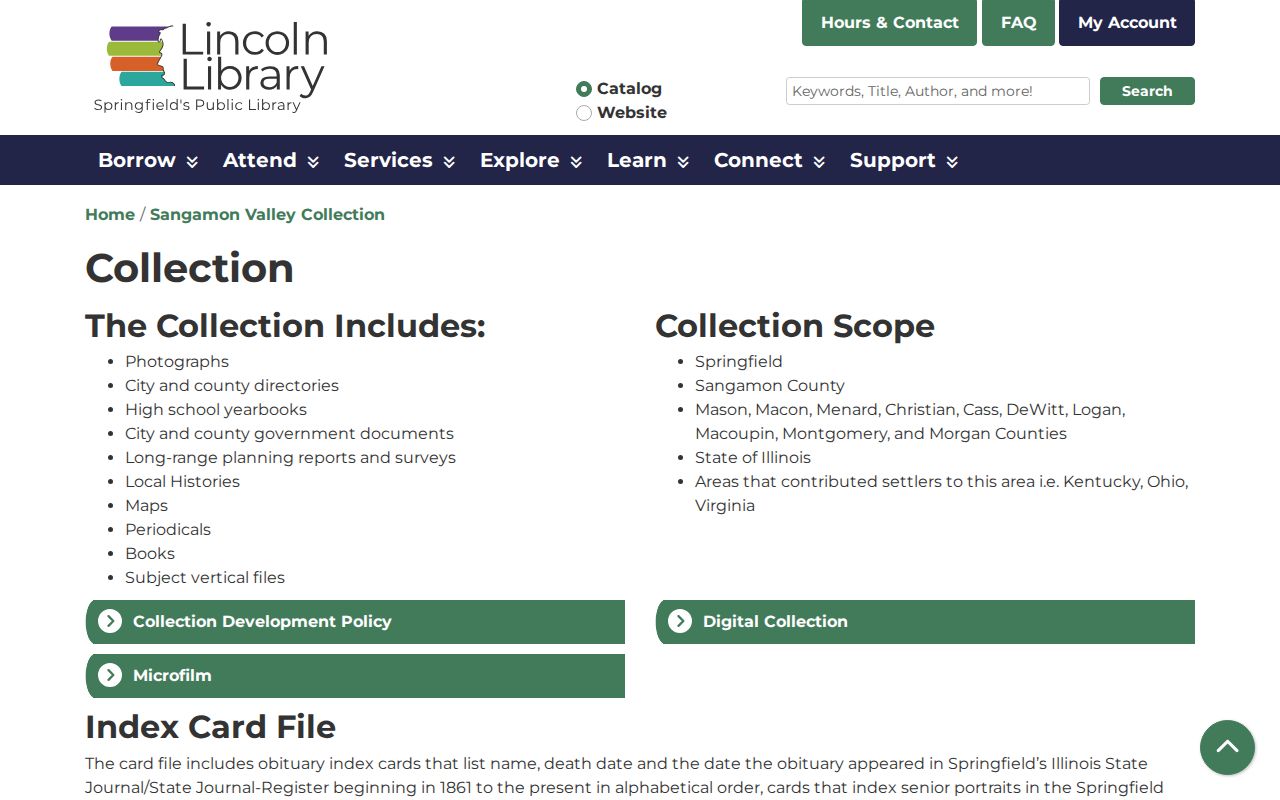
That range matters because each item proves something different. A photo may show a facade, a map may date a footprint, and an obituary may connect relatives, but none replaces the deed or census record.
Springfield Maps and Permit Clues
Sanborn fire-insurance maps are building sources, not occupant rolls. Verified Springfield editions include 1890, 1906, and 1917, with later 1950 and 1952 volume or reprint records. Use them to compare a building footprint, materials, use, lot form, street name, and number near a known year. If a current address fails in an old directory, compare the Sanborn sheet, cross streets, parcel description, and annexation record before deciding that the house or family vanished.
The Springfield City Clerk's FOIA directory lists permit applications, reports, files, index cards, Sanborn material, Sidwell books, Tax Index Number and Owner files, street-name records, annexation files, and engineering maps. No public address search was located for those series. Use the online City FOIA request or the inspection route, give the exact address or legal description, limit the date range, and name the record type. That focused request can add construction, alteration, applicant, inspection, and old-number evidence to a Springfield previous residents file.
Note: The research found no verified citywide street-renumbering year, so preserve old address wording and request the underlying street-name file.
Springfield Archives Beyond the Web
Older address work often ends at an archive rather than a portal. The UIS Sangamon Experience research collections hold regional primary documents, images, manuscripts, oral histories, and university archives. Lincoln Library points to newspapers and local indexes. The Abraham Lincoln Presidential Library offers newspaper microfilm and manuscript access by appointment, while the Illinois State Archives and IRAD hold older municipal, court, coroner, jail, school, and town series.
The UIS research page shows the archival route available when published Springfield previous residents sources run out.

Contact the repository with a name, address, date range, and record type. Archivists can identify relevant collections, but they should not be asked to conduct an unlimited genealogy or title search.
Confirm Springfield Previous Residents
A disappearance from a directory is only a lead. Search the Sangamon Valley Collection obituary cards, then read the cited newspaper issue. Check cemetery material, probate or court indexes, and an eligible vital record when the question calls for them. A move may also appear in a property sale notice, permit, or later directory. Preserve the name spelling, role, date, page, and custodian for each item so a same-name person is not merged into the wrong Springfield household.
The best house-history packet is mixed: parcel card, deed, directory entry, census household, map, permit, and newspaper. The 1926-cataloged Jeffersons scan even has a printed-title date discrepancy. That local quirk is a strong warning to inspect title pages and images instead of copying catalog labels. Previous residents are supported by agreement among records, not by one search result.
Lawful use. Research Springfield previous residents for family, house, estate, or civic history. Never use an address trail to watch, threaten, or harass a living person.