
Springfield Directory Shelves by Year
The local collection is spread across a Springfield library room, digitized scans, genealogy catalogs, and reference holdings. Lincoln Library confirms that its Sangamon Valley Collection holds city and county directories, but it does not publish a complete current shelf list online. Call staff for exact years and call numbers before visiting. The verified runs below are evidence of available editions, not a claim that every year is held at every site.
| Collection | Years | Where held | Access |
|---|---|---|---|
| Winters and Jameson Springfield directory | 1857–58 | Internet Archive scan; SVC acknowledged | Free digital scan and OCR |
| Early city and county references | 1866, 1868–69, 1876 | St. Louis County Library reference list | Reference collection |
| Sangamon County directory and gazetteer | 1889 | FamilySearch catalog | Catalog status must be checked |
| Springfield directory references | 1892–93; selected 1924–38 years | Reference list and digitized item | Mixed shelf and scan access |
| Later directory references | 1957–59, 1978, 1980, 1987 | Reference list; verify SVC holdings | Ask collection staff |
Publication gaps do not prove that a household left Springfield. A volume may be missing, publication may not have been annual, or the person may have been omitted. Pair the directory year with newspapers, census records, deeds, vital records, or another nearby edition.
Springfield Directories at Lincoln Library
The Sangamon Valley Collection is on Lincoln Library's third floor at 326 S. Seventh Street. The noncirculating room was established in 1970 and serves Springfield, Sangamon County, and ten adjacent counties. Published hours are 10:00 to 5:00 on Monday, Tuesday, Thursday, Friday, and Saturday, with Wednesday hours to 8:00 and Sunday closed. Call 217-753-4900, extension 5634, to confirm an edition.
Its collection guide lists city and county directories, high-school yearbooks, photographs, maps, local histories, government and planning documents, periodicals, books, and vertical files. Staff help matters because reverse sections and complete directory runs are not enumerated on the public page.
The official collection page shows the local-history desk and its research scope.
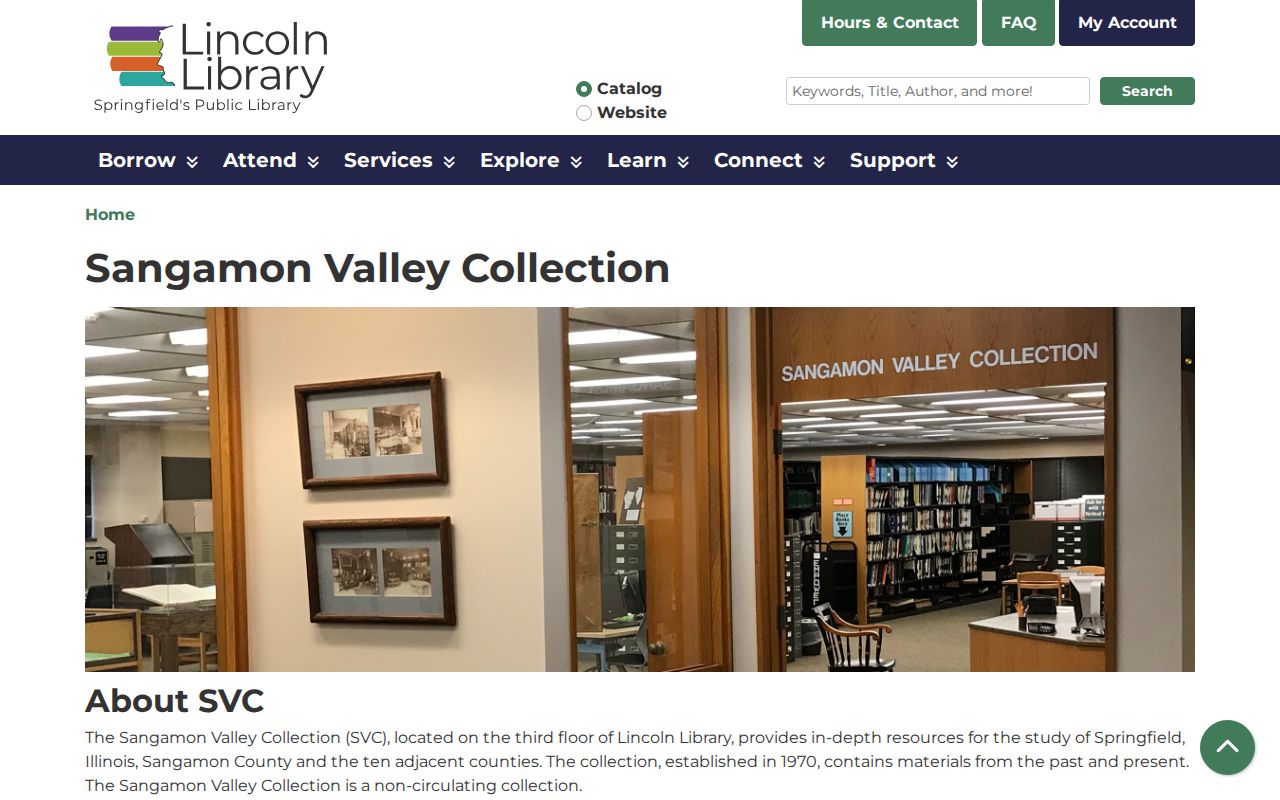
The room is the best local place to join a printed directory entry with maps, yearbooks, newspaper film, and vertical files.
Springfield's 1857 Directory Online
The earliest verified digitized Springfield city directory in the research is the 1857–58 scan. B. Winters & Co. compiled it, S.H. Jameson & Co. published it, and the Sangamon County Genealogical Society produced a 1990 reprint from the original. The item acknowledges Lincoln Library's Sangamon Valley Collection.
The volume includes alphabetical entries and an abbreviation key. One inspected entry identifies J. H. Adams as a hatter, gives a business location at “33 square,” and places his house on the north side of Monroe between Spring and College. That compact line is useful evidence for a name, trade, and place in one printed year. It is not proof of present occupancy.
The digitized directory allows the title page, page image, and OCR text to be compared.
The image should control when OCR drops punctuation or mistakes initials, street abbreviations, and old type.
Read a Springfield Directory Entry
Never copy an old line without its key. Early Springfield entries compress direction, street side, residence, work, and cross-streets. Later directories may add a spouse, phone, children, and owner symbol. Record the printed wording first, then expand it in a separate note.
| Name | Often initials and surname; check nearby entries and spelling variants. |
|---|---|
| Occupation | A trade and sometimes an employer or business address. |
| Spouse or widow mark | Parentheses or widow notation can separate same-name households. |
| House location | Number, street, side, cross-streets, or “h” and “r” residence marks. |
| Phone and family marks | Later editions may include a phone, child count, and an owner star. |
- Criss-cross directory
- A street-order section used to move from an address to the printed occupant.
- Householder index
- An address-focused list of people identified as heads or occupants.
- Abbreviation key
- The volume's own legend for terms such as cor, ns, ss, h, r, lab, and compass points.
Photograph or cite the key with the entry. “Office” may be a work site, while “h” or “r” marks a residence. Neither tells who else shared the home.
Check Springfield Scan Title Pages
A Jeffersons item is cataloged as a 1926 Springfield directory, yet its scanned title page and OCR say 1920. The item calls itself the eleventh annual directory and describes residence, business, miscellaneous, street, and street-car sections. This mismatch is a strong warning: a catalog label is a finding aid, not the final citation.
Read the scanned title page, publication statement, copyright page, and foreword. Then record both the catalog label and the printed date if they conflict. The Jeffersons conventions also need the volume key. A number after the spouse can indicate children under fifteen, and a star in the street directory can mark a property owner.
Note: Cite the Springfield date printed inside the scan, and preserve the conflicting catalog year in a research note.
Bridge Springfield Directory Gaps
The SVC indexes and pathfinders connect a disappearing name to dated sources. Its obituary card index covers 1861 to the present and records both a death date and the date an obituary appeared in the Illinois State Journal or State Journal-Register. That pair leads to the right newspaper issue; the card itself is not a death certificate.
Local databases add several routes. Advantage Archives holds scans of titles including the Illinois State Democrat for 1858–60 and small-area papers from the 1880s through 1918. HeritageQuest adds census and city directory material. HeritageHub covers obituaries and death notices, while Ancestry Library Edition and FamilySearch affiliate access are available through the library. Yearbooks can supply a face and class year.
Search surname variants, initials, married names, and OCR errors. A person absent from one directory may have moved, died, chosen not to be listed, or appeared under a different form of the name. The obituary card, next directory year, and census help distinguish those paths.
Springfield Civic Names Since 1832
Lincoln Library's City Officials Index covers mayors, aldermen, and commissioners from 1832 forward. It grew from Helen Van Cleave Blankmeyer's manuscript, donated to Sangamon State University Archives in 1975. A sample entry gives “ALVEY, WILLIAM,” the year 1835, and the source code HSC957. That pattern links a person, civic year, and cited history without claiming a household address.
Office titles changed as Springfield's government changed. The city incorporated in 1832, received its charter in 1840, used commission government from 1911, returned to an aldermanic form in 1987, and adopted its strong mayor and aldermanic form in 1991. Directory front matter lists officials through 1953; later names are found in the general index under City Officials.
The manuscript's path from a local researcher to a university archive and library index is part of Springfield's record story. Preserve the office title and year exactly, since “commissioner” and “alderman” belong to different civic structures.
Springfield Life Beyond Directories
The Sangamon Valley Collection's microfilm preserves records that surround a directory entry: council ordinances from 1877–1973 with an index beginning in 1855, police sergeant journals from 1917–79, school attendance from 1885–1927, city cash records from 1924–57, and county election returns from 1862–67. These are separate sources with different indexing rules, not one resident list.
Use them after a city directory supplies a name, address, school, public role, or date. The focused question might be whether a street improvement reached the block, whether a student appears in an attendance book, or whether a civic event was recorded in an ordinance. Collection staff can explain film order and available indexes.
Choose a Springfield History Archive
Several Springfield institutions hold different parts of the historical directory trail. Lincoln Library is the first choice for directories, obituary cards, local papers, maps, and yearbooks. UIS Archives and Special Collections holds regional manuscripts, oral histories, election returns, and university records, with weekday appointment access. The Abraham Lincoln Presidential Library has more than one hundred Springfield newspapers on microfilm and requires a researcher card, appointment, and collection requests through Aeon.
The Sangamon County Historical Society research sources point researchers to newspaper film, local publications, libraries, and archives while warning that some popular local writing includes invented detail.

The referral list helps route a directory clue to the institution most likely to hold the supporting source.
State Archives and IRAD are better for older county and municipal books. Ask a narrow question that includes names, record type, place, and date range. Archives are far more effective when the city directory has already supplied a firm year and address.
Trace Springfield Families by Directory
Follow a Springfield household across editions rather than treating one entry as the whole story. Keep an image citation or page number for each year and note all changes in spelling, spouse, trade, address, phone, and owner symbol.
- Find the first likely alphabetical entry and copy it exactly with the edition year and page.
- Check the street section for the same address, then note neighbors, cross-streets, and any owner mark.
- Move to the next older and newer available editions to bracket a move, marriage, death, or name change.
- Pair the closest released census year through HeritageQuest or FamilySearch, allowing for ward and boundary changes.
- Use obituary cards and newspapers for dated family events, then confirm deeds or vital facts with the official custodian.
A directory gap is a question, not an answer. If the name vanishes, search the spouse, an initial, the old address, nearby years, and the newspaper index. For a current parcel and owner chain, move to the Springfield street directory workflow rather than projecting an old entry onto today's household.
City directories are strong time-stamped clues. They become family history when their names and addresses are reconciled with census, newspaper, deed, archive, and vital evidence.